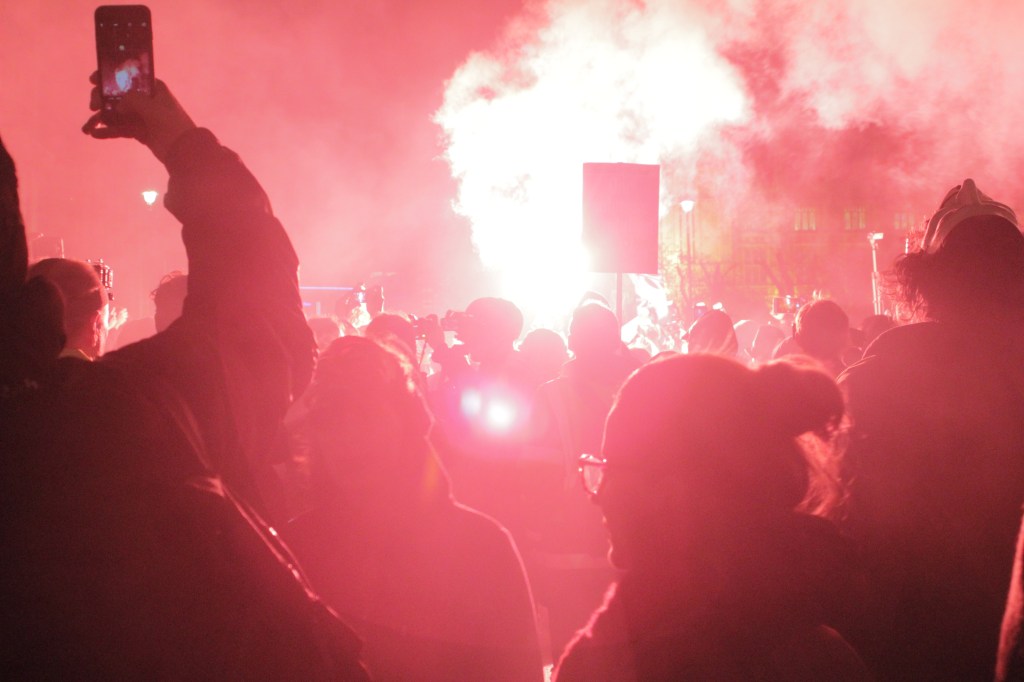
Today I inaugurate a ten-part process of sharing snippets from my forthcoming monograph, Digital Initiation Rites, alongside fieldwork images, in anticipation of its publication by Cornell University Press, on 15th December 2025.
1/3 Bonfire Night
It is November 5th, 2014, a date known annually as ‘Guy Fawkes Night’ or ‘Bonfire Night’. Nominally, it is a celebration of the foiling of a Catholic plot in 1605 to assassinate the English king and destroy the Houses of Parliament, marking the day when one of the plot’s leading architects, Guido or ‘Guy’ Fawkes, was discovered beneath it with thirty-six barrels of gunpowder and a match. Yet throughout its four-century plus history, this ritual has come to stand for contradictory things. Despite being originally instituted as a ceremony of remembrance to reinforce the Protestant hegemony, it soon took on a lively and distinct folk existence of its own, emerging as an evening for drinking, feasting, and the lighting of fires.[1] In this subaltern life, Bonfire Night evolved into an occasion for licentious behaviour and score-settling, with vengeances falling along segmentary lines that often possessed an economic character. Punitive landlords had their fences removed and burned, unpopular employers had stones thrown at their homes.[2] During the particularly riotous years that followed the French Revolution, these altercations coalesced into the emergence of the ‘Bonfire Boys’—groups of young male artisans, labourers, and craftspeople, who blackened their faces with soot, or covered their heads with cloth, and roved the streets throwing hand held fireworks and transgressing moral codes, in what was also called ‘Mischief Night’.[3]
Digital Initiation Rites (2025, p. 4-5)
[1] On this folk history see Cressy (1989, 1992).
[2] See Cressy (1992) and Hutton (1996), on practices of fence-stealing in the eighteenth and nineteenth century. On the latter, Hutton documents that, ‘On 5 November 1828 a masked crowd threw stones and fireworks at the house of an unpopular employer at Luton’ (1996, 399).
[3] Cited in Hutton (1996, 382). The ‘Bonfire Boys’ remain an enduring institution in Britain’s largest bonfire night festival in the town of Lewes, though much of former rule-breaking character of the Bonfire Boys has been contained through its institutionalisation (Etherington 2001).
 Vita Peacock
Leave a comment